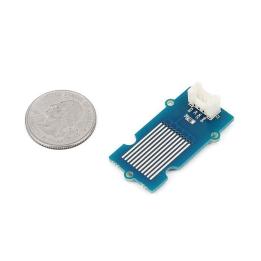
Water level and rain sensor with analog output: water on the exposed traces makes them conduct, and the S pin outputs a voltage that rises with the wetted area. Connect it to an analog input of Arduino, ESP32 or other boards to detect rain, leaks or the level of a liquid.
Key features
- Sensing area of about 40 x 16 mm with 10 interleaved conductive traces
- Analog output proportional to the wetted area, amplified by an NPN transistor
- Power LED on board
- Pre-soldered 3-pin header and two mounting holes
- Works at both 5 V and 3.3 V
Technical specifications
- Model: T1592 (Water Sensor)
- Power supply: 3 V to 5 V DC
- Operating current: less than 20 mA
- Output: analog (S pin)
- Sensing area: 40 x 16 mm
- Board size: approx. 62 x 20 mm (pins excluded)
- PCB: double-sided FR4, HASL finish
- Operating temperature: 10 °C to 30 °C
- Ambient humidity: 10–90 % non-condensing
- Pins: S, +, -
Pinout
| Pin | Function | Arduino connection |
|---|
| S | Analog signal output | A0 (or another analog input) |
| + | Power 3–5 V | 5V, or a digital pin (e.g. D7) to power it only while reading |
| - | Ground | GND |
Usage tips
- Mount the sensor vertically with the traces pointing down: water must reach only the traces, never the components or the header.
- The reading is not linear and depends on water conductivity: note the values with the sensor dry, half immersed and fully immersed and use them as thresholds in your code.
- If it is powered all the time the traces corrode by electrolysis: power it from a digital pin switched on only for the reading, e.g. digitalWrite(7, HIGH); delay(10); int level = analogRead(A0); digitalWrite(7, LOW);
- With ESP32 and 3.3 V boards power the sensor at 3.3 V so the S signal stays within the input's allowed voltage.
- It is an indicative sensor: ideal for detecting water and an approximate level, not for precision measurements.
Package contents
- 1 water level and rain sensor with soldered 3-pin header
Typical uses
- Rain sensors for weather stations and automatic shutters
- Flood and water leak alarms (basements, washing machines, boilers)
- Level control in small tanks, aquariums and plant pots
- Educational Arduino projects
Nota sulle fotoLe foto sono scattate da noi o fornite dal produttore e verificate sul prodotto reale. Il prodotto ricevuto può differire nell'aspetto (colore, marcature, confezione o lotto), mantenendo funzioni e caratteristiche tecniche dichiarate dal produttore.